gurdymonkey: (Default)

What with the time change and it being the first Sunday of the month, I was up an hour earlier than I had any need for - except having to pee. So it was I decided to take a stab at the Antiques by the Bay flea market over on Alameda Point. 

This used to be fun. Now not so much. Even getting there at 8 AM, there's a ton of people hoping for bargains, many dragging carts or wagons, bonus points if there are recalcitrant children along. Sure, masks are required, but people are so focused on looking at the stuff around them that they tend not to look where they're going. 

No decent Japanese antiques to speak of. Lots of shabby chicified crap, tons of old clothing, plenty of mid century furniture which was uncomfortable in 1965 and still is, you suckers. I was, however, keeping an eye out for, yes, you guessed it, Yixing wares. I even found some. One vendor had a couple of pots but they were really small and I wanted something that will hold 100/150 ml water at a serving. Kept walking and dodging. Found someone else had a couple pots but without lids, and no marked prices (the woman had to ask her husband for prices on every little thing, so I moved on). 

Saw another table vendor on a corner, had several pots about the size I was looking for (and that was either old tea or dust inside some of them), prices ranging from $60 to $150. Told him I would think about it and made a mental note of where he was located. 

Kept walking, braved the portajohns (which at that time of morning were in good condition and the pump sinks still had soap, water and towels), and found another Chinese couple with easily half a dozen pots in varying shapes and sizes, prices attached with blue painter's tape. And the guy was happy to chat. You like tea? Yes, I'm looking for something for oolongs. What kind you like? Ti Guan Yin? (Smile.)  This good for one cup. This good for share. This (an ox with long horns and a child sitting on his back as the knob for the lid) to look at (miming putting it on shelf). Which is how I ended up with a $50 pot for $40.


Was home by 10:30, and put it into a pan of clean water to warm on the stove for about an hour on basic general principle, simply because I have no idea how old the pot was. Found some black floaters when the water had cooled and I poured it out. Jade had suggested to sniff the wet pot - yep, smells like clay, so that is a good sign. I did notice that the water doesn't absorb the way it does on the other pot, but that could be a result of the construction - the outer carved wall gets smudgy grey spots on it as it dries, but then they go away. I don't want to apply soap though - it could get absorbed and screw up the flavor of anything I try to brew in it. 

Just did a comparison brew with Old Ways Teas Jin Mu Dan, a nice roasted oolong and honestly could not tell the difference between what I brewed in the gaiwan and what I did in the pot. Jade says it depends on the tea. Some teas it's more noticeable than others. And this could be a young pot. ;)

Going to go back for a second cup. Maybe a hint more minerality in the flavor. 
 

gurdymonkey: (Default)


10s @ 200F, half portions (about 2g) in flavor neutral gaiwan and unglazed clay teapot, using identical teacups. 

On huffing the bag, the scent is black tea and flowers. Leaf is dark and tightly twisted. Good red gold color in the cup for both brews.

This is special, all right. Flavor is deep, with a fruity, sweet plummy thing melding with those floral aromas, and a darker, slightly spicy thing going on in the background.

The Yixing zisha clay teapot is brand new. It's been properly rinsed and seasoned, but it's NEW. My rational brain is yelling at me that it has not had time on a single steep to do anything. Emperor's new teapot and all that. But - is that black licorice???? The difference is so subtle I'm having a hard time being objective. Is the clay brewed tea flavor just the teensiest bit warmer? Or is my brain just wanting it to be?

I don't know. What I do know is that this is a delicious tea and I will dump the gaiwan leaf into the teapot and happily enjoy more steeps.

From the seller, info about this tea. https://verdanttea.com/spring-laoshan-gongfu-black-special-grade 

Second steep, all in the teapot, drinking from a thicker walled chawan now. Still delicious, warming. This tea is a winner and I need to make sure I note that on my spreadsheet. 

In other news, that high edged plate from Reannag Teine works quite nicely as a tea boat. The plate was a token from the late Countess Berengaria for representing her in the 2018 Valkyrie Rose Tournament at Great Western War. Miss you, Bera.  These clay teapots benefit from getting wet with tea, so you're supposed to overfill the pot a little bit, which means you need something that catches the water, like a "tea boat" or slotted tea tray with a reservoir under it. (If you saw "The Blind Banker" episode of "Sherlock," there's a scene showing the Chinese ceramicist character pouring tea this way as part of maintaining the pot.)

In the "Phew, I didn't buy a fake" column*, the pot pours efficiently and elegantly without the need for a strainer, the lid fits snugly and the pot sheds/absorbs water from the overpour almost instantly. Besides, that woodgrain pattern is just gorgeous! (Buying off the internet makes it hard to examine what you're getting and the shipping mixup on the extra teapot set alarm bells ringing in my head. BTW, they emailed yesterday to tell me to please keep the extra teapot as a gift and would I mind giving them a review? So I did: pleased with my purchase but careful to point out how long it took to ship and that they did send that second pot by mistake, which means somebody somewhere did not get their order, so I hope they're fixing that.)

Third steep, darker and even richer because I let it steep for a bit longer. Good stuff, this! 
 

gurdymonkey: (Default)
This is what the color green smells like. Strong vegetal scent out of the bag, and the leaf is greeny black. I probably could have hit this with boiling water and it would stand up just fine, but I stayed conservative with 200F for a 10 second steep to start.

Classic black tea flavor with that grassy green note, but not bitter at all, in fact, it's got a subtle sweetness. (I'm enjoying it with a slice of buttered toast.)

The website's description indicates this tea comes from old growth, wild tea trees and is processed by letting it dry in the sun. https://verdanttea.com/qianjiazhai-wild-picked-black-tea

Second steep, 212F/13 seconds and it's just fine. The bright vegetal top note still shines through.

I have to admit I don't like this as much as the Zhou Rong or the Golden Fleece, but they have very different characteristics and that's ok. According to the grower, this tea gets better with age - and it was just picked this spring. Might put this one away for awhile then and see what it does. (I should write myself a note on the bag because I won't remember.) https://verdanttea.com/how-its-made-shai-hong-qianjiazhai-black-tea-sheng-puer

Might be worth cold brewing this one, but it's a rainy day and I'll have at least one more cup hot on basic principle. 
gurdymonkey: (Default)

 No place to be this Saturday so I slept in, then decided to look at my recently acquired collection of Little Green Pouches from Verdant Tea and pick out a tea to enjoy. This morning, it's the 2021 Golden Fleece sourced by Wang Yanxin.


This is another tea that smells delicious when you unseal the package and inhale. It was like opening a package of dried apricots. Or maybe mango: sweet and fruity was the main impression, anyway. 

Verdant's website furnishes all sorts of details about each tea. This one comes from 40 year old wild growth Yunnan Da Bei tea bushes grown at an elevation of 2000m (6561 feet: Donner Pass in the Sierra Nevada is 7057 feet) in the Lincan region of Yunnan Province. This batch was picked in the spring of this year. 

First steep: 200F (they recommend 205F, but my kettle settings offer 200F and boiling, so I opted for a slightly cooler temperature), 8-10 seconds, add 3 seconds for each additional steep.  

The aroma keeps the fruit and overlays it with a gently floral note. It's sweet and soft on the tongue. There's a lot going on but it's all subtle and soft and stays that way even as it cools in the cup. "Here, (whiff of jasmine). "Here, (cool silk on your forearm). "Here," (is that apricot)? 

I don't know. I am not an expert and taste is VERY subjective. The tea seller may list things in a flavor profile and I'll be sitting here and going, "Banana? What banana? I don't get banana at all!" 

This is not an in-your-face wake up cuppa. I feel like I should be in a garden pavilion, swathed in silk, composing poetry to the sound of bird song. (Even as a motorcycle starts up next door and sets off the crows.)

The second steep is just as soft and relaxing as the first. About to go for a third. 

Lovely stuff! 

 
gurdymonkey: (Default)
It's October, which means hot drinkies are back on the menu. One of my FB friends posted an ad from Verdant Teas last week and they had 10% off on their tasting kits which include five 25g bags of tea, so I sprung for the Liquid Gold assortment. Which, of course, arrived late Friday after a very long week and I knew I needed not to be up all night after dosing myself with caffeine. And there was an event Saturday, so I didn't get around to a session until today.

All the teas come packaged in resealable mylar zip lock pouches (which is good because all my tins are spoken for at the moment) - and there was a freebie 5g sample Laoshan roasted oolong in my shipment as well, which is one of those touches I always appreciate.

The Zhu Rong is named for "a legendary dagger-wielding warrior-queen of Yunnan descended from a god of fire." The blurb from Verdant Tea's website continues: "The toasty-savory spice and sweet, creamy boxy of this Yunnan black tea evoke the kingdom of Dian, an independent state before it was conquered by China and renamed Yunnan. Dian Hong is a relatively new kind of tea introduced in the 80's that has recently taken China by storm for its full body and depth of flavor that comes rom its signature downy buds. While budset black teas from Fujian tend to be very crisp, Yunnan golden bud harvests like this Zhu Ron are much bigger and creamier."

I just about fainted from delight when I inhaled the scent coming from the newly opened bag. Heavenly! Sweet spices, honey (or maybe caramel), toasty notes. I could have stood there happily huffing the bag, but it was time to pour some water on these beautiful golden brown twisted leaves. 


My Cuisinart kettle pre-sets don't quite jive with the recommended temperatures on any of these teas, so instead of the 205F listed, I opted for 200F - slightly lower doesn't seem to hurt much, but too high will not bring out the tea's best. First steep was a fast 8 seconds, with 5 seconds added for each successive steep.

Tea is a lovely reddish gold in the cup, no bitterness at all, soft on the tongue. Try to imagine a honey that was not sticky or cloying, just a clear, sweet flavor that holds up beautifully to multiple steeps. (On the third at this writing, can probably get several more easily.) 

Definitely a tea fit for a queen!

gurdymonkey: (Default)
 Greetings, 

This letter is to follow up on my email of August 27. 

Sturgis Motorcycle Rally: 500,000-plus attendees, 330 cases in the hosting county. 178 cases of Covid across five states, 58 hospitalizations, likely many more to come. https://www.nbcnews.com/news/us-news/south-dakota-covid-cases-quintuple-after-sturgis-motorcycle-rally-n1277567

Lollapalooza: 375,000 attendees, 203 cases, no hospitalizations or fatalities, proof of vaccination or a negative Covid test required. https://apnews.com/article/entertainment-music-health-chicago-coronavirus-pandemic-99fd8448a981a47d934eac70aa1e19b0?fbclid=IwAR3T0W_I9RwUKk62Sc1POXcK_oY-x4zyBpGGglKLqc9MBLXUN2bJBLz_Vqg

I can't sit down inside a restaurant in San Francisco without proof of vaccination. My employer will not let me come to work without proof of vaccination. More and more state and local governments, health systems and private businesses are requiring proof of vaccination to work, play, use their facilities, be in their spaces. 

Why don't we? 

I urge the SCA to require proof of vaccination for attendance of in-person events, practices and other official activities. A chivalrous society protects its people. 

Let's do that. 
 
Saionji no Hana
Royal Rapier Marshal
Order of the Laurel, West Kingdom
 
gurdymonkey: (Default)

Good morning,

My name is Saionji no Hana, a member of the Society since 1995, a Companion of the Order of the Laurel, and currently serving as Royal Rapier Marshal in the Kingdom of the West. I also run rapier at a local branch practice on Thursday nights: in compliance with county, state and Kingdom requirements, it is held outdoors and while fighters have the option of not wearing face masks under helmets/fencing masks, they must wear them when their “hats” are off. Compliance has not been a problem.

I have spent the past week grinding my teeth in anger and frustration while in self imposed quarantine awaiting Covid testing results.

On the morning of Saturday, August 21, 2021, I received an instant message from someone who attended our practice: he had just tested positive for Covid-19 and wanted to let me know. I immediately messaged my principality and kingdom seneschals asking what I should do. When more than an hour had passed without response, I pulled the contact tracing sheet from that night’s practice and called everyone on it to inform them that they had possibly been exposed to the virus. At no time did I divulge the participant’s name while doing so.

When my Principality Seneschal responded, she told me to notify everyone who had been at the practice – which I had already done – and to hang onto the contact tracing sheet in case the health department needed it. My Kingdom Seneschal’s initial response was to tell me that I didn’t have to inform anybody except as a courtesy, but it was nice that I had. It was not until much later in the day, the deputy Kingdom Seneschal informed us that the Society Seneschal “confirmed that contact tracing sheets, which Society states will only be given to Public Health, should not be used to contact individual participants. General, carefully worded warnings posted to Social Media are OK, but we can’t use the info on those sheets unless directed to by Public Health.”

This confused mess is of a piece with the entire process of reopening practices starting in mid June in my kingdom. At that time we were told masking would be required and that we were to collect contact tracing information – but given *no* guidance on what that information was supposed to be or what we were supposed to do with it. I knocked together a spreadsheet, duly collected names, etc. at my practices and saved the sheets. It was weeks later when someone (I believe it may have been the deputy Kingdom Seneschal) put together a sample tracing form with instructions to turn them over to our branch seneschals and published them on the kingdom website.

It took me the better part of a day to find out what to do in case of a self-reported positive test, precious hours that could be used to book testing appointments, self quarantine and prevent possible spread of a virus that does not care about rules, only to be ultimately told that doing the right thing was the “wrong” thing.

I’m a marshal. My job is to keep people safe. I am allowed to tell a fighter that their equipment is not safe to use. If a fighter’s behavior on the field is unsafe, I can warn them to change the behavior, I can pull them off the field, I can even revoke their authorization card. As my kingdom’s Royal Rapier Marshal, I can even publish rules stricter than the Society standard if I deem it necessary to keep people safe. But I’m not allowed to pick up a phone and say, “You may have been exposed to Covid-19 Thursday night.” We’re not allowed to say, “Proof of vaccination is required to attend in-person activities.” (The only reason we can require masks in my area is because state and local government already do and the Kingdom is in compliance.)

As the Delta variant spreads, more and more businesses are requiring proof of vaccination to enter them or to work in their locations, insurers are raising rates on the unvaccinated. Being unvaccinated is an unacceptable risk.  Further, my employer sends me daily emails reporting any positive Covid cases at any jobsite in the company as required by law.

As a private organization, the SCA can choose to require proof of vaccination and masking – and has chosen not to.

I accept certain risks as a fighter. I can mitigate some of them by keeping my kit well maintained and safe, by calling holds when I see a hazard, even by declining to fight if the situation warrants. I can get vaccinated and wear a face mask, but I can’t see a virus. We simply do not know enough about breakthrough infections in the vaccinated population yet. Covid-19 doesn’t care about honor or choice or whether someone might sue: it exists to spread and it’s really good at it.

My job as a marshal and as a peer is to protect my friends and the SCA is making it harder to do than it should.

We can do better and we must.

Saionji no Hana, OL, Royal Rapier Marshal
Kingdom of the West

++++++++++++++++++++

Response from the Board of Directors: 

I’m so sorry that you were exposed to coronavirus. I hear the frustration that you just feel in these words you have written even though it’s tough, usually, to sense tone in an email. 
 
I am Gigi and Friday is my day to respond personally to the emails we receive, although each director reads every email we get. We rotate days to do this so you know you’ve been heard, but more than that, so you know we are listening. 
 
The next time we discuss our policy the words you have shared here will be considered. You’ve made some good points and by sharing this example you give us an idea of how our guidelines are or are not working well in practice. 
 
Take care and thank you again. 
 
Best,
Gigi Coulson, MS
Director Seat A, SCA
Ombudsman for Æthelmearc, Avacal, Drachenwald, Ealdormere, Lochac, and the corporate DEI Officer
931-639-9337
Maestra Giata Magdalena Alberti, OL


gurdymonkey: (Default)

 Last night, Brann MacFinnchad did a tea post around 9PM my time and I thought, "I want tea. No, if I have tea I'll wake up at 3 AM and not get to sleep. Oh, fuck it, tomorrow's Saturday, go make some tea." 

I decided to open up a packet from Old Ways and I honestly do not remember whether this was something I ordered or a freebie they put in my last shipment a few months ago. So I looked it up and determined it was an oolong, set the kettle at 190F and put some in my gaiwan. It is now Saturday afternoon and I am on steep #4. (First steep was 190F for 20 seconds, second was for 30 seconds. Today's steeps were turned up to 200F with no adverse effect and steeped for 45 and 60 seconds.) 

Anyway, Jin Mu Dan (which means "Golden Peony,") is a roasted hybrid of two oolong cultivars. The leaf came out of the packet a deep tobacco-y brown. It steeps to a honey gold in the cup which is probably how it got it's name. Delicate floral aroma and some fruity notes with some sweetness, though I am now noticing a light astringency that makes your tongue feel dry and reach for another sip. That may be because we're several steeps in. 

Nice tea though. 

If you're looking to get into Chinese teas, oldwaystea.com is a good place to start. While their products are all from one tea region, specifically the Wuyi mountains of Fujian Province, they offer a nice variety of teas in amounts that make sampling a breeze (you can buy as little as 5 - 8 grams, which is enough for one or two tea sessions and if you don't like something, you don't feel like you're stuck with a tea that was a dud. Both times I ordered, my package included a free sample and a nice little card thanking me for my order. And they do bundles and a bi-monthly tea club if that appeals to you. 

gurdymonkey: (Default)

Akira Kurosawa had been planning "Ran" ("Chaos") for a decade after reading about real-life Sengoku warlord Mori Motonari and his three loyal sons and trying to imagine what would have happened instead if they had been bad. It was later that he learned of the parallels between what he was conceiving and Shakespeare's tragedy, "King Lear," and began fusing them into a story, elaborately storyboarding it with hundreds of paintings. Following the success of the critically acclaimed "Kagemusha," he was able to secure the financial backing of French producer Serge Silberman. (Yes, that castle, a set purpose-built on the slopes of Mount Aso, is burning down for real, as the distraught Hidetora staggers unhindered through the armies of his warring sons, an empty scabbard dragging behind him.) 

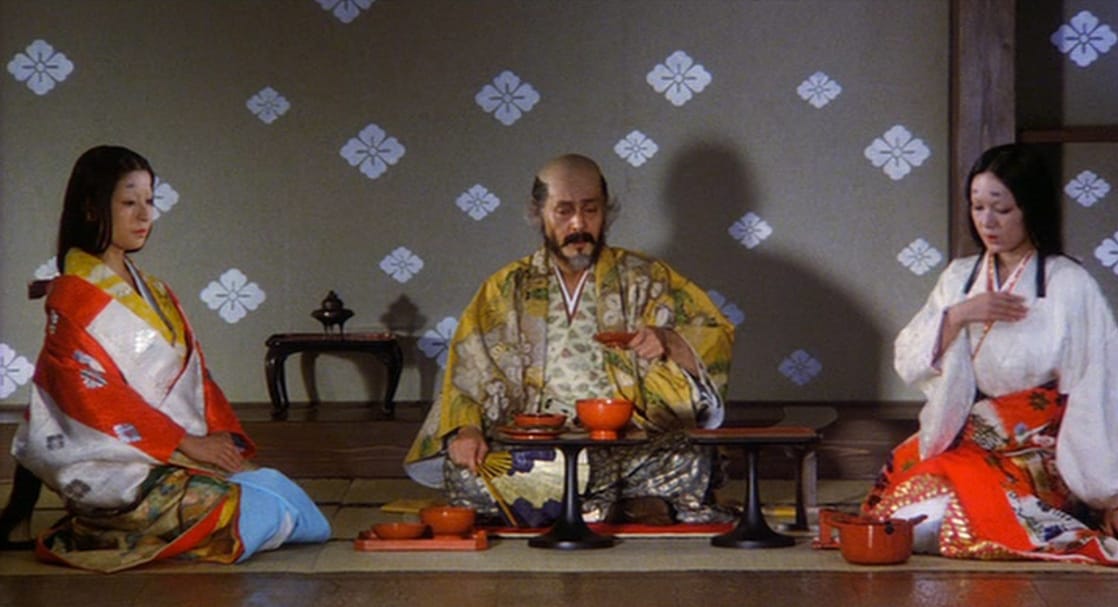
Emi Wada's sumptuous costumes won an Academy Award and are gorgeous. The period is appropriately the Sengoku Jidai (late 16th c.) and we meet our "Lear," Lord Hidetora (Tatsuya Nakadai) hunting deer with his sons, Taro, Jiro and Saburo, in the mountains. 


 In this post hunt scene, Hidetora and his sons are relax in a curtained enclosure with refreshments. They are all in beautiful hitatare ensembles and wearing folded eboshi (caps), clothing that signifies high rank and a degree of formality. 

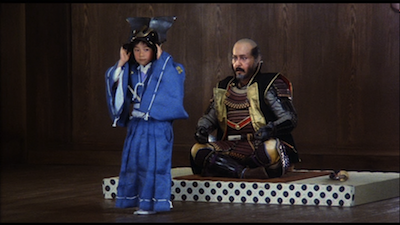
The old lord dozes off, then wakes with the determination to divide his domain. Taro is to become leader of the Ichimonji clan and receive his first castle, with the other sons to receive castles of their own and orders to support their elder brother, while Hidetora retains his title as great lord. Saburo, the middle son, protests that this is foolish and dangerous and when one of Hidetora's retainers, Tango, comes to his defense, Hidetora banishes Saburo and Tango. 

It all spirals down from here. Lear's great sin in that tragedy was foolishness. Hidetora's, we come to see, is cruelty, as his past ruthless acts as the head of a clan come back to bite him. 

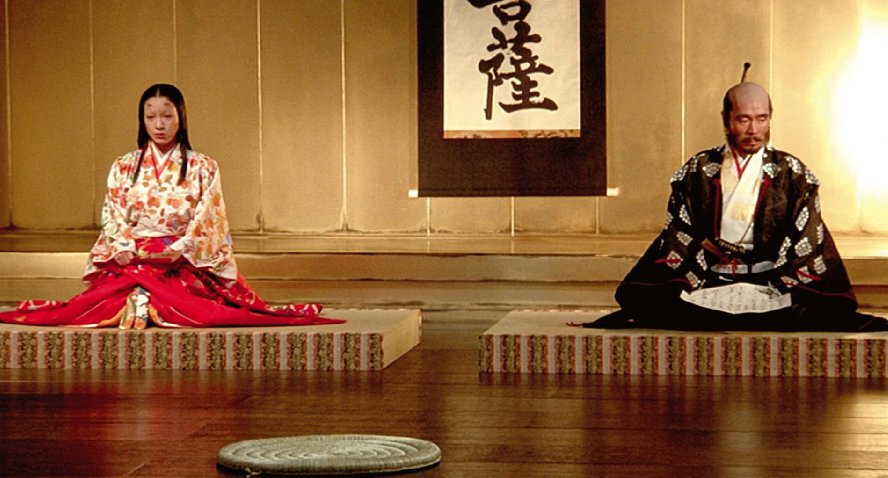
Let's talk about Taro's wife, Lady Kaede (Mieko Harada), here with Taro (Akira Terao), both of them looking like subjects from period portraits in this shot. Kaede's family was murdered by Hidetora, their lands taken, and she was forcibly married off to his son. She sees Hidetora's abdication as a way to make him pay. So she will. (She also gets to wear some gorgeous stuff in the process!)

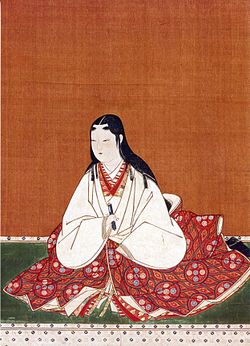
She has her uchikake (outermost robe) tied around her waist in a cool, summery style. You can see the tips of her front tied obi peeping out in the center, as well as some of the layers of robes as the collar, similar to this 16th c. portrait of Oichi no Kata. Taro is dressed in formal hitatare. 

This uwagi is spectacular, in a dan gawari pattern of alternating blocks of dark red and white decorated with pauwlonia blossoms. The layer beneath it appears to echo the pawlonia motif. 

Another dan-gawari uchikake, this one in heavy metallic brocade. 

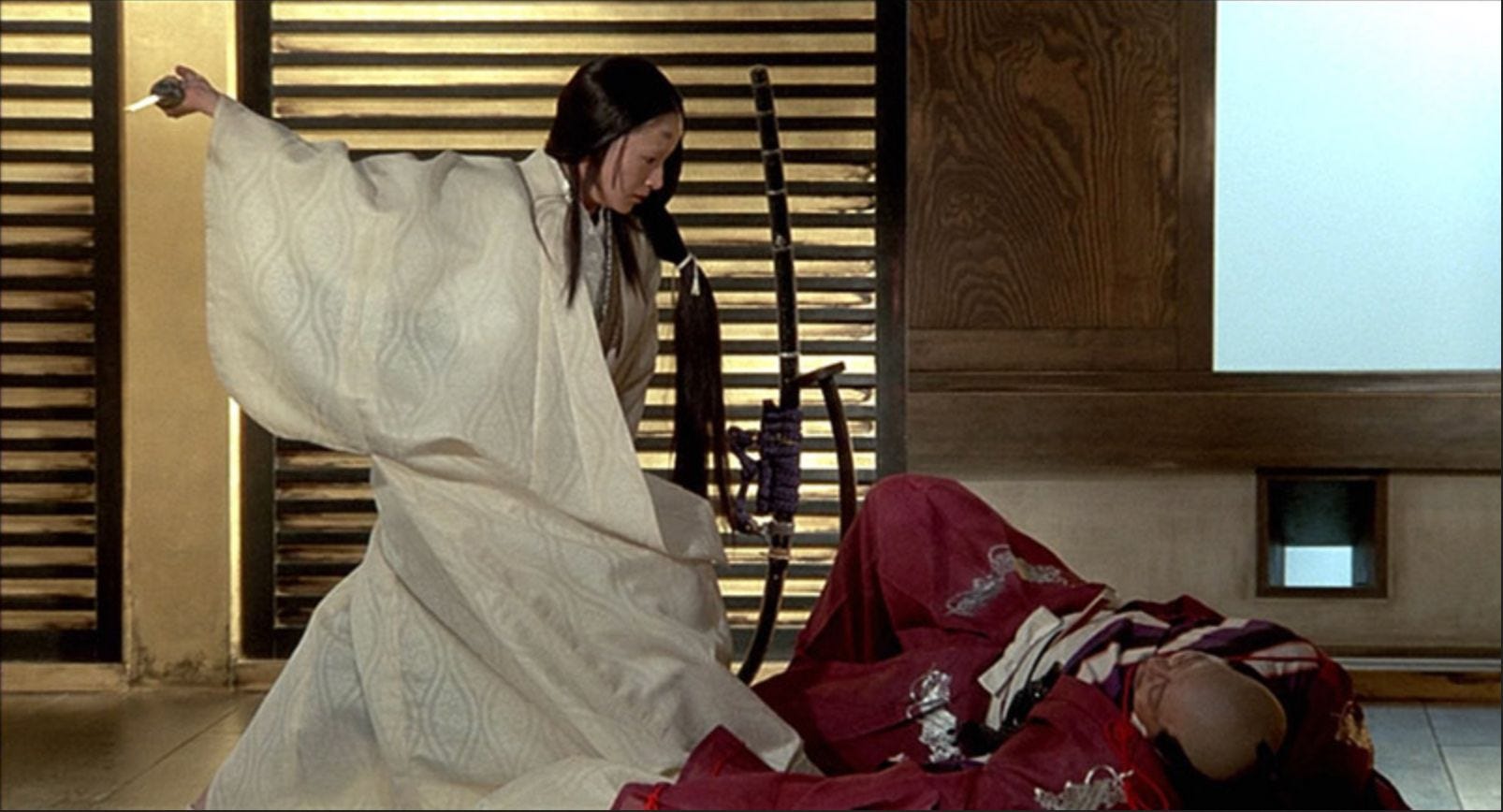
When her husband is killed, Kaede (in mourning white) comes to his brother Jiro, first demurely presenting her husband's helmet, then unleashing her rage in a disturbing scene where she holds a blade to her brother in law's throat and seduce/rapes him. The aftermath as the camera follows her obi, trailing like a snake on the floor as she puts it back on, is one of those Kurosawa touches. The silvery black and white she wore beneath the white is almost like scales. 

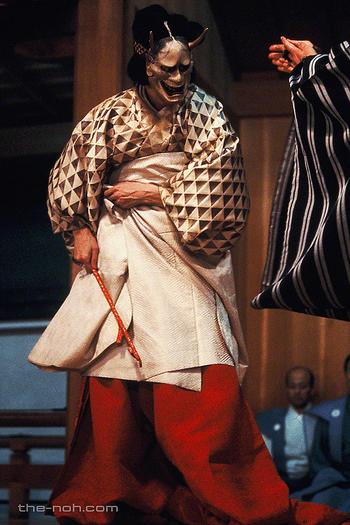
Then designer Emi Wada pulls out all the stops with this number as an unrepentant Kaede faces her fate. That triangle pattern is symbolic of snake or dragon scales used in Noh - compare to the costume from the play "Dojoji" 


gurdymonkey: (Default)

5/21/21: Yesterday my rapier-legal wakizashi arrived from Castille. The tsuka (hilt), machined out of brushed aluminum, was left bare as specified, because I want to wrap it to match my katana. The blade is 18," which means it's a dagger by SCA rules, but it's got some heft to it, enough that it should be just fine against C&T weapons. 

Quick backstory: I bought a katana at Great Western War several years ago from James the Just, who had mounted a Castille blade in a wooden tsuka. We discovered the tsuba didn't hold up to cut-and-thrust combat a couple years back, at which time I ordered a steel tsuba from Castille, stripped the original lacing, and wrapped the existing wood core with rayskin and green silk ito.

The tsuka profile of the wakizashi is more oval than the rectangular grip on the katana (also by JTJ), so they were not going to be perfectly matched, but it will pass muster from a few feet away.

For reference information, I used the hiramaki pattern from Thomas Buck's The Art of Tsukamaki. Free for Kindle with diagrams and full color photos, it's an excellent manual.

5/22/21: I soaked the ray skin in a dishpan for about half an hour or so to soften it up, took a pattern off the waki tsuka with some watercolor paper, then patted the ray skin dry with a paper towel. This skin was smaller and a little thinner than the one I used for the katana - in fact, the reason I have it was that I'd ordered it for the katana and it wasn't long enough. Anyway, this time I was able to cut it with shears instead of an X-acto blade. I left it a little long in case of shrinkage, wrapped it around the tsuka with a few old hair ties and let it dry for 24 hours.

5/23/21: After several false starts that I wasn't happy with, I realized that part of the problem was the curved shape of the tsuka was making it hard for me to get the lacing even. The other part of the problem was that the smaller ray skin wasn't quite grabby enough to get the silk to catch on it. I took a break, had some iced tea and a think and then dug out the double sided craft tape I use for my war fan. I know, heresy, but a strip down each side was just enough to allow me to get a more even wrap.

I also decided to skip the menuki. The handle on this is so short that the menuki was going to run into the beautiful natural rayskin node and I didn't like how it looked. (Since I didn't strip the katana tsuka yet, I won't have to redo that one with new menuki to match. I had to buy two new sets since I couldn't find any to match the old ones, but they were inexpensive alloy reproductions and perhaps I'll use them as special tokens to give to people.)

I was running out of ito as I neared the end - there was not going to be enough to do a more traditional end-knot over the top of the end cap. Ultimately I finished the wrap off with a neat square knot, trimmed the ito and clamped the ito ends under the end cap. It looks neat, it's not going anywhere, and I'm not going to have to untuck and untie a complicated knot if I ever need to unscrew the end cap again.

gurdymonkey: (Default)

 I found a surprise on my doorstep this morning in a USPS Priority Mail box from my friends Joshua and Ellen Badgley (aka Ii Saburou Katsumori and Abe Akirakeiko). So of course I fired up the kettle. 


According to the label, this bohea (pronounced boo hee) is "a distinctive black tea blend with a light smoky flavor. It was so popular in colonial times that bohea became the common word for tea. It was imported in larger quantities than all other teas combined, and it was the majority of tea destroyed during tea tax protests in revolutionary America."

Good smoky aroma on opening the tin and the leaf is very black. Suggested brew time on the tin was 5 minutes at 195 F. My kettle settings allow for 190 or 200 and since I was not going to be drinking this with milk or sugar, I brewed for 2 minutes at 190. Flavor was nicely smoky, light and not at all astringent. 

That made me sufficiently curious to see if it became bitter on a longer steep, so I did a second cup at 200F for a full 5 minute steep. When the timer went off and I went back in the kitchen, I could smell the smoke aroma wafting out of the spout of the kyusu. 


I can understand how this could be a nice everyday cuppa for our colonial forebears. 

Available along with a number of other varieties from Colonial Williamsburg's shops.

Tea trivia: Say "boo hee." Now say "woo yee." Bohea is from the Wuyi mountains of Fujian Province, a place renowned for such teas as Da Hong Pao (Big Red Robe) oolong. Black teas such as Jin Jun Mei are also from that region. During the 17th - 18th centures as tea exports to the West really began to take off, new names for various grades of tea came into use. Bohea came to be associated with the cheapest grade of black tea. Cheap is not necessarily bad. In this case it meant more people could afford it and drink it, which is why the blurb on the tin about its use in the Colonies makes sense. Modern price at Colonial Williamsburg is $16.99 for 3 ounces or 85 grams, or about $ .20/gram, which jives with the least expensive black varieties at oldwaystea.com. Their cheapest smoked black tea is $0.38/gram.

I was sufficiently curious to see if the bohea would become bitter on the longer steep, so I did a second cup for a full 5 minutes at 200F to see what would happen. The timer went off, I rounded the corner into the kitchen and immediately got a faceful of smoke aroma, but that might be because I'd left the top off the teapot. Color in the cup is slightly darker than the shorter first steep, but not by much. And no, it didn't get bitter! 

So a hat tip to Colonial Williamsburg for quite a nice smoked tea. If you're a milk and sugar tea person, it's robust enough to handle it. If you want it plain and a little lighter, simply reduce the steep time. Good stuff. 

EDIT: I threw the steeped leaves into a tall glass with some water and cold brewed it overnight. The color was a bit weaker than the first two steeps, but the flavor was still nice. So if you like smoky flavors, this works well as an iced tea. 


gurdymonkey: (Default)

What happens when you take Edmond Rostand's "Cyrano de Bergerac," set it in feudal Japan and give the lead to Toshiro Mifune? 

In 1959, Toshiro Mifune was averaging half a dozen films a year, yet, I'm willing to bet many of my readers have never heard of this film. Admittedly, it didn't make it to a US release until 1973, and while the Criterion Channel now offers it on their streaming platform, a decent DVD version has yet to be released. (If Criterion does release it, I will happily buy a copy.) I discovered it via a grainy capture on Youtube some time ago - and I was enthralled. Today I found a decent downloadable version with subtitles here. 

"Life of an Accomplished Swordsman" may be a better translation for the title, but "Samurai Saga" is less of a mouthful and is what you can sometimes find it as. Mifune had previously worked with director Hiroshi Inagaki on the three "Samurai Trilogy" films based on Eiji Yoshikawa's sprawling novel about Musashi MIyamoto.

I am unable to read the Japanese opening credits and have not been able to find anything on who designed the costumes for either the Musashi trilogy or "Samurai Saga," I must lament that fact, because we're talking some proper eye candy.  However, Yoshiaki Ito is credited as the Art Director and Production Design was by Kisaku Ito. (Psst! Criterion! I'm looking at you. Do a nice DVD release!) 

Our story begins in 1600 at an outdoor theater by the Kamogawa River in Kyoto. A group of samurai allied to Lord Tokugawa who have come to see Okuni sing and dance. It's a great scene with a lot of bustling as people come to watch, vendors hawk snacks, and the scene for a confrontation is set. As it happens, we have a painting from about 1603 depicting Okuni dancing with a sword before an audience in just such a theater. (Historical aside: this is generally recognized as the origin of kabuki drama.)

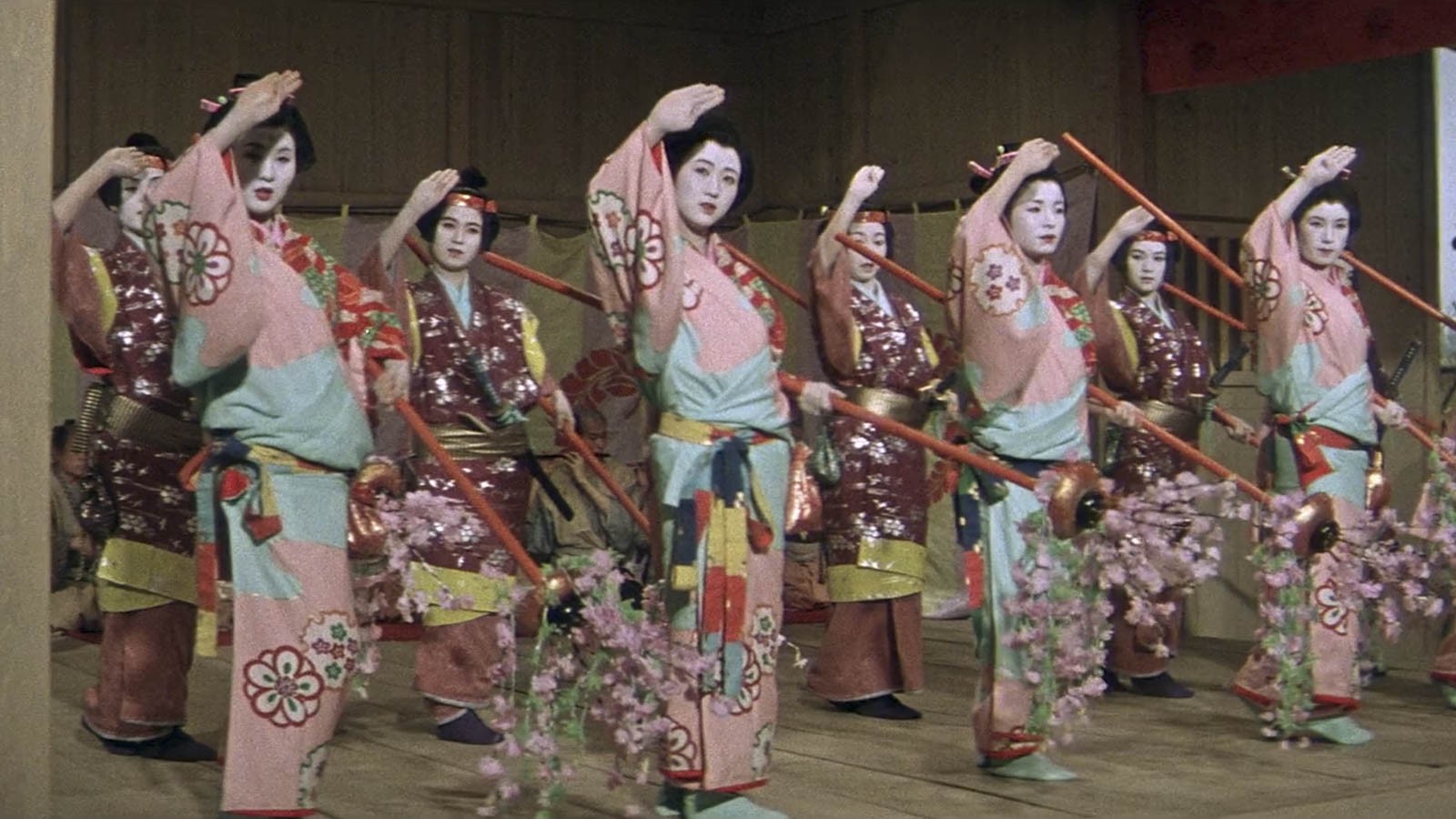
Immediately, We Have Weirdness. These dancers are wearing hairstyles that are much, MUCH later than the period this is supposed to be. I wonder if Toho Studios was able to wrangle some geisha and maiko to perform  the dances, because that's the vibe I'm getting. Yet, when you look at the almost slouchy, kosode with the soft, narrow obi tied on the hip, those are right in the ballpark they should be. And it is a weirdness because there are other women in that crowd scene with hairstyles that look correct for the period. Did the studio not have enough period-appropriate wigs for the cast? I am stumped, because the costumes look quite good for the period. Check out the "boy" costumes, complete with swords, in the second row of dancers and compare to the figure of Okuni in the painting. 


Okuni (Eiko Miyoshi), is old and not particularly attractive - her updo is similar to what one might see on a sex worker of the period. (See my post on the character of Kiku in "Shogun.") She has received a threatening letter warning her not to perform that day. She takes the stage, even as members of the audience speculate as to what will happen next. 

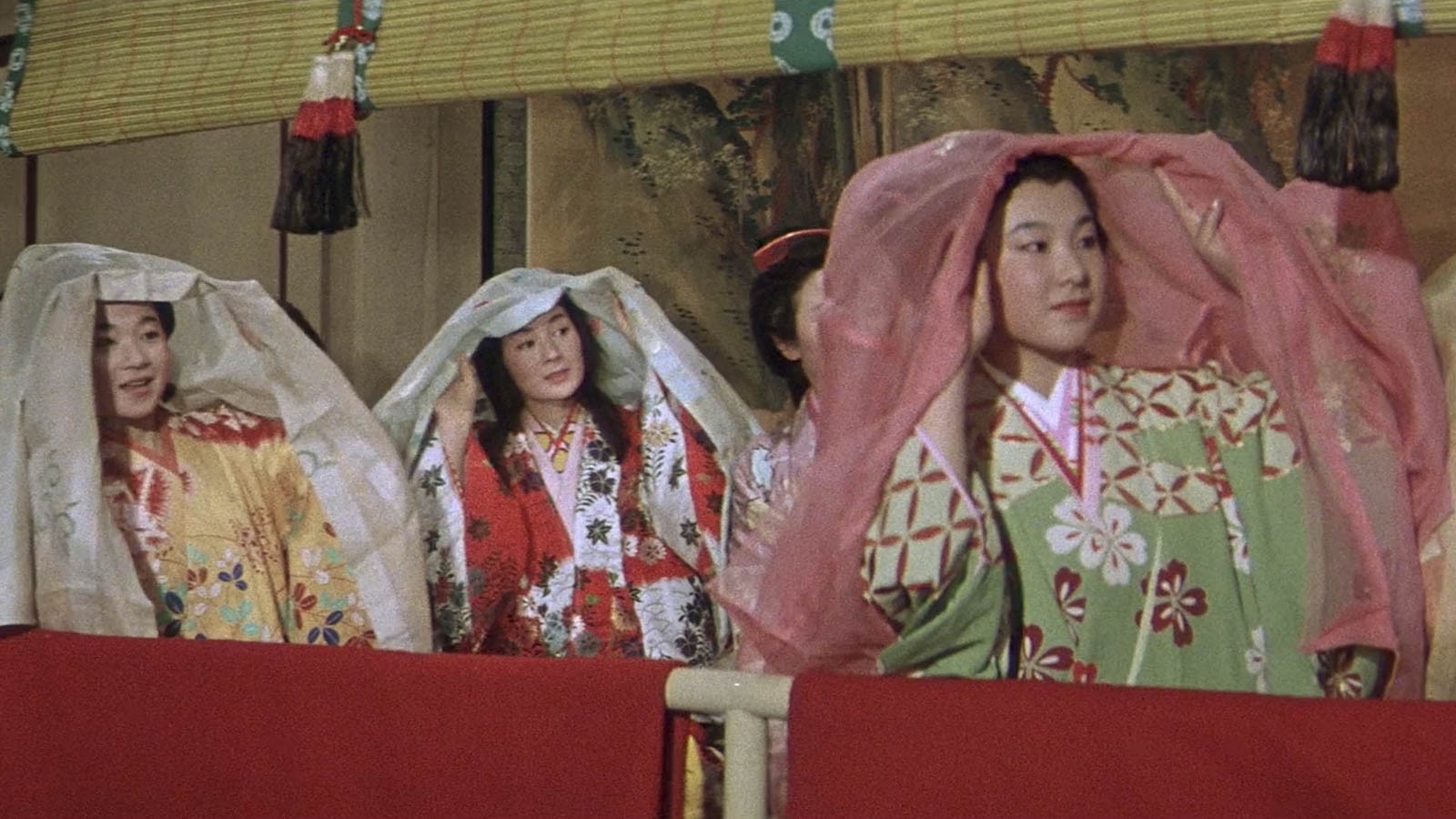
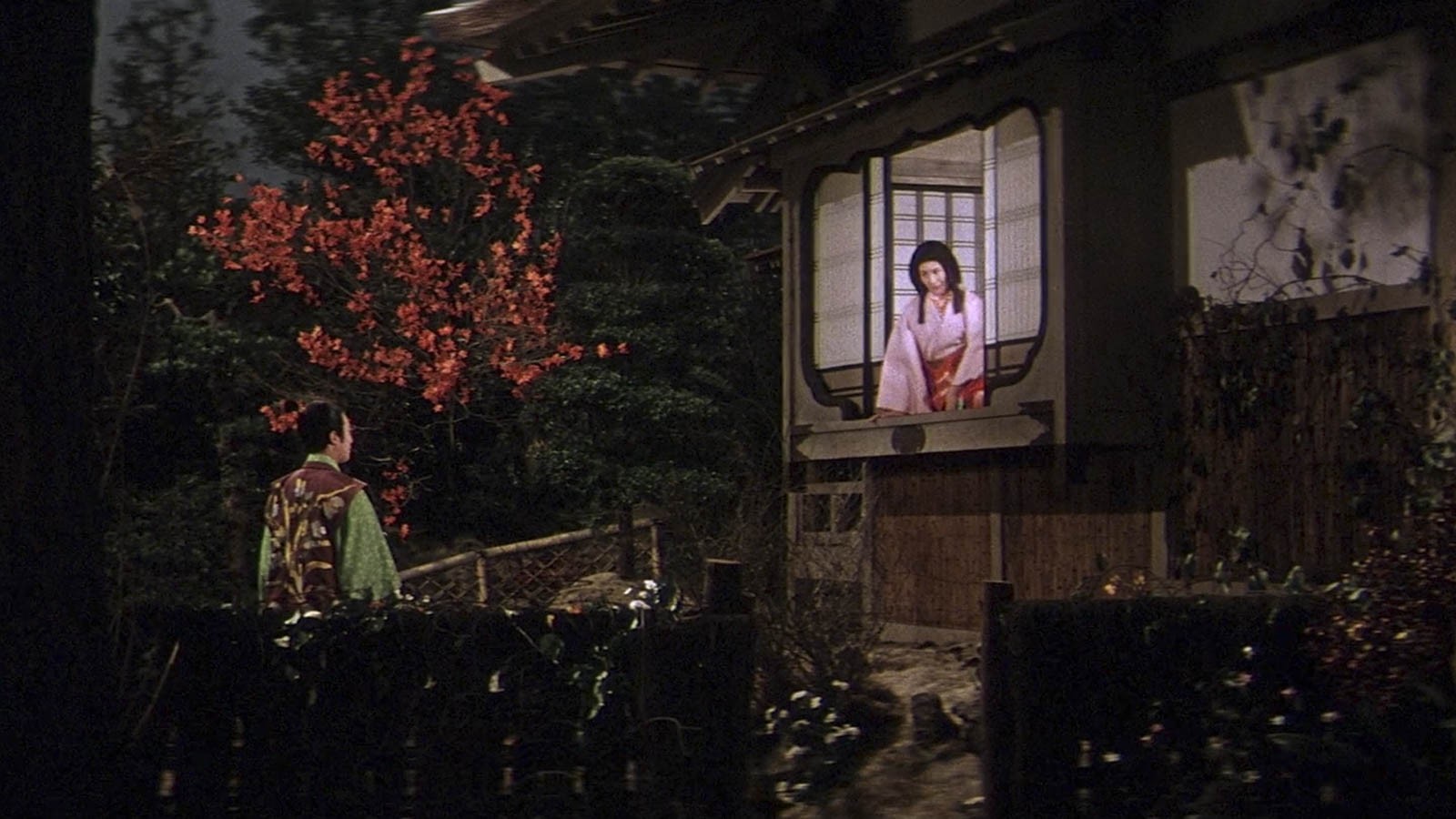
More importantly, a handsome young samurai named Karibe Jurota (Akira Takarada) catches sight of the lovely Princess Chiyo (Yoko Tsukasa, in red and white below) as she and her friends waft into the theatre to take their seats. These ladies look like they stepped right out of the Okuni screen painting. Chiyo-hime is particularly stylish in a dan-gawari uchikake.  

Okuni manages to warble a few nervous notes, until a voice thunders from the back of the theater, accusing her of disloyalty to her late lord and patron Toyotomi Hideyoshi by performing on the anniversary of his death. 

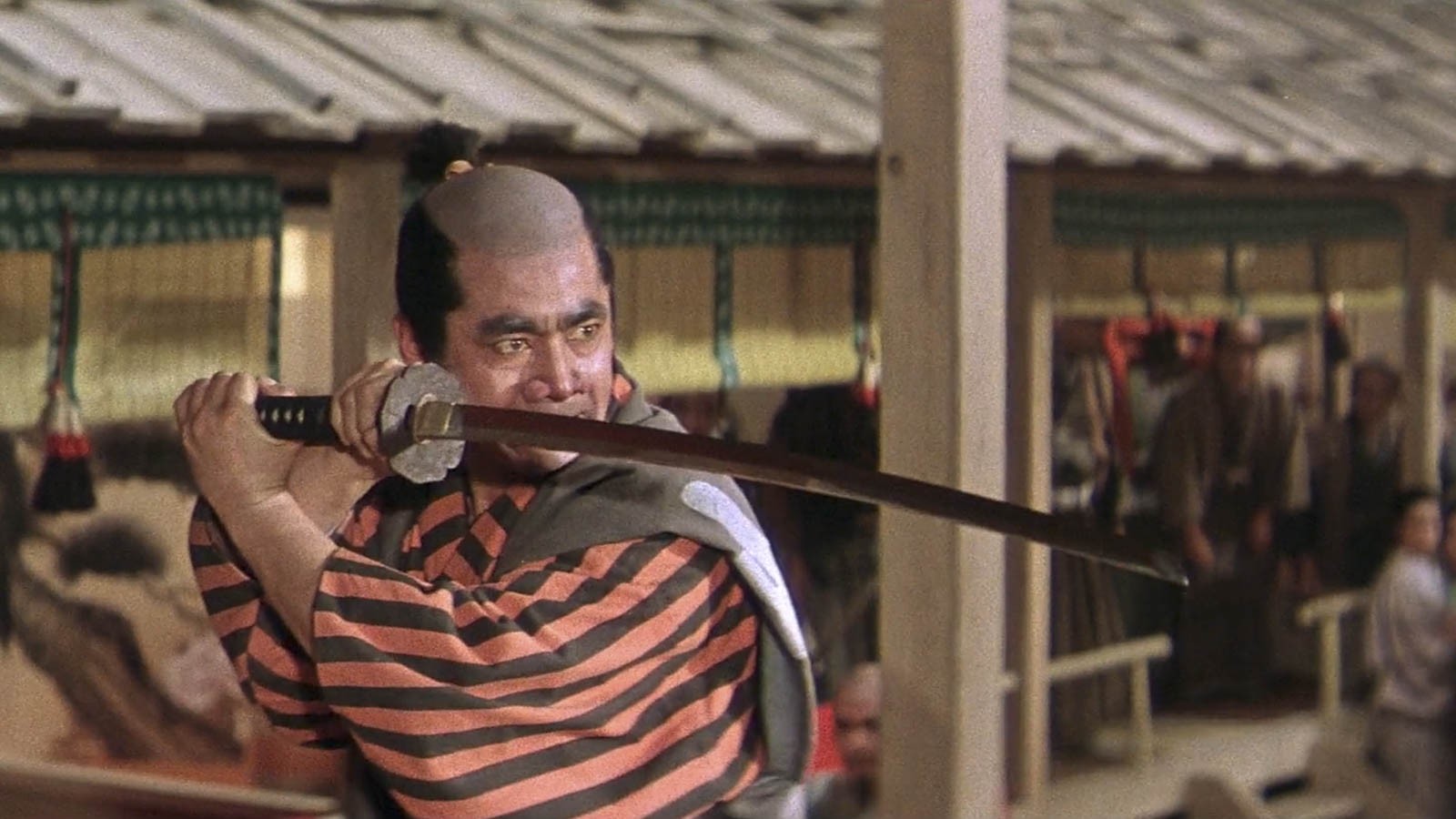
Komaki Heihachiro (Mifune) appears, dressed in the livery of Lord Ishida's retainers. His broad nose with flaring nostrils is a departure from the usual flamboyant beaks seen in depictions of Cyrano de Bergerac. I suspect this might be to do with the legends of tengu, long nosed, dangerous beings of supernatural origins. Long noses are also seen in depictions of Westerners that appear in the Black Ship Scrolls


Some of the Tokugawa faction. 

Nice shot of the back of Heihachiro's dobuku. It looks like applique of a pine tree motif. 

Okuni flees the stage, the Tokugawa faction leap out of their seats, and one of them hurls a lame "big nose" insult, which Heihachiro promptly uses to demonstrate that he's not only heard 'em all, he can do much, much better, for he is a poet. Mifune performs the poetry with the stately movements and chants that evoke Noh performances, interspersed with his usual lightning sword-work, but a non-Japanese audience might not get that. So the English subtitle are rhymed couplets for the subtitles, precisely because Japanese poetry doesn't rhyme. Kudos to whoever did the translation. 

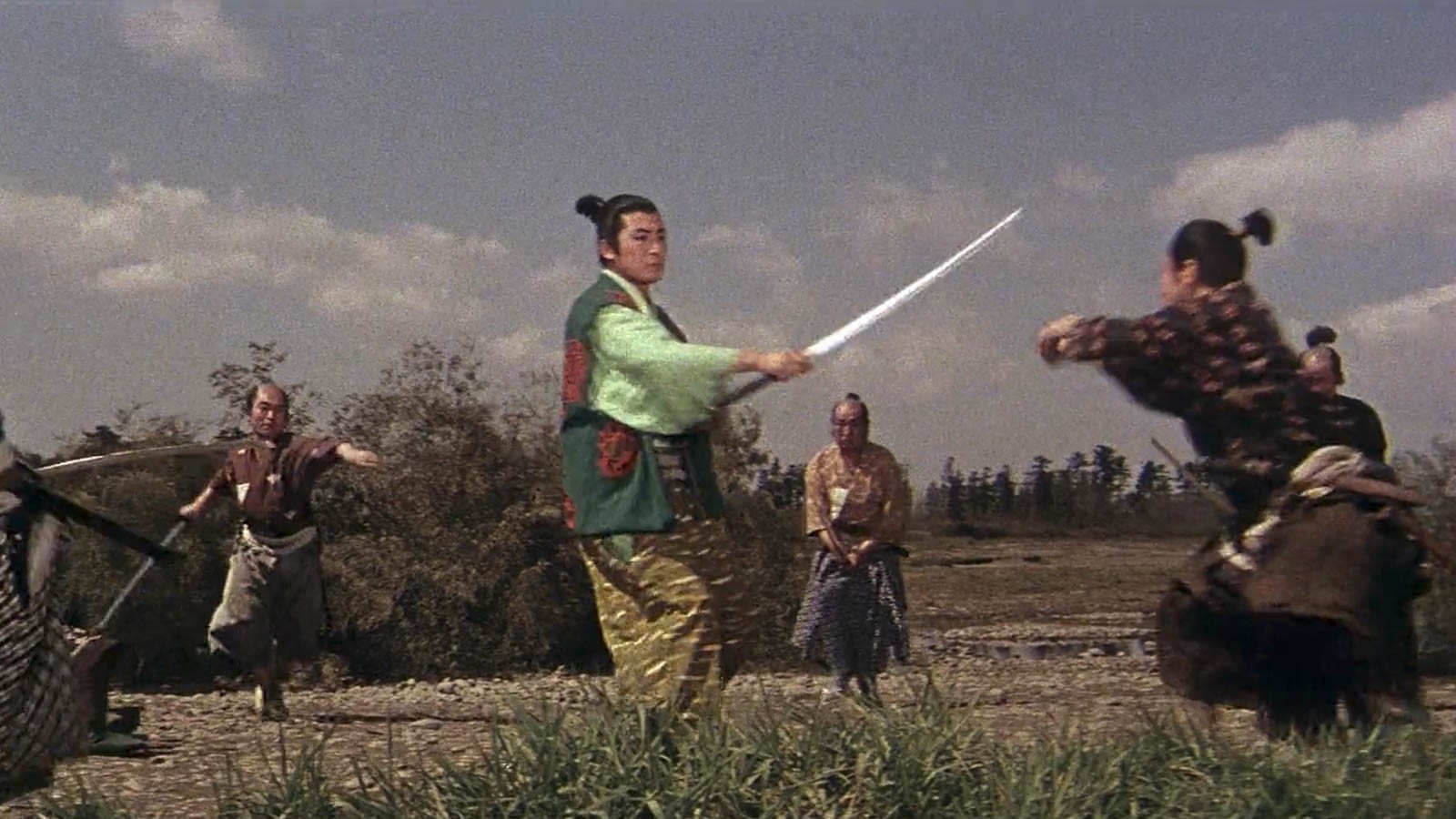
This sets in motion a later ambush of one of Heihachiro's similarly liveried friends, Akaboshi (Akihiko Hirata), in which Heihachiro again defeats superior numbers with his mad martial skills.
 
Left: Akaboshi in Ishida livery, different dobuku. Right: Namae is disheveled but still gets pretties to wear. 

Above: A better look at Chiyo's dan-gawari uchikake.

We are treated to a series of scenes in Heihachiro's neighborhood, establishing his kindness to the people around him: a local girl who is crazy or simple (can't really be sure), Heihachiro's "day job" teaching boys to read and write, the innkeeper and wife with whom he lodges, and his relationship with Lady Chiyo. He's always loved her, she looks on him like a brother. 

You know where it's all going. Let's have screen shots! 

 
Left: Heihachiro tells his comrades how he defeated the Tokugawa. Right: Writing poetry at a scenic overlook. Note the gourd and the poems tied to tree branches.

 
Jurota makes some "nose" comments: Heihachiro like's the kid's spirit. Jurota takes on the Tokugawa. He and Heihachiro bond. 

 L
This uchikake with the stripes and morning glories is so gorgeous - and I suspect it was based on this 16th c. portrait of Oinu no Kata

  The balcony scene: Chiyo has her uchikake worn koshimaki-style around her waist in a summery style. So pretty. 


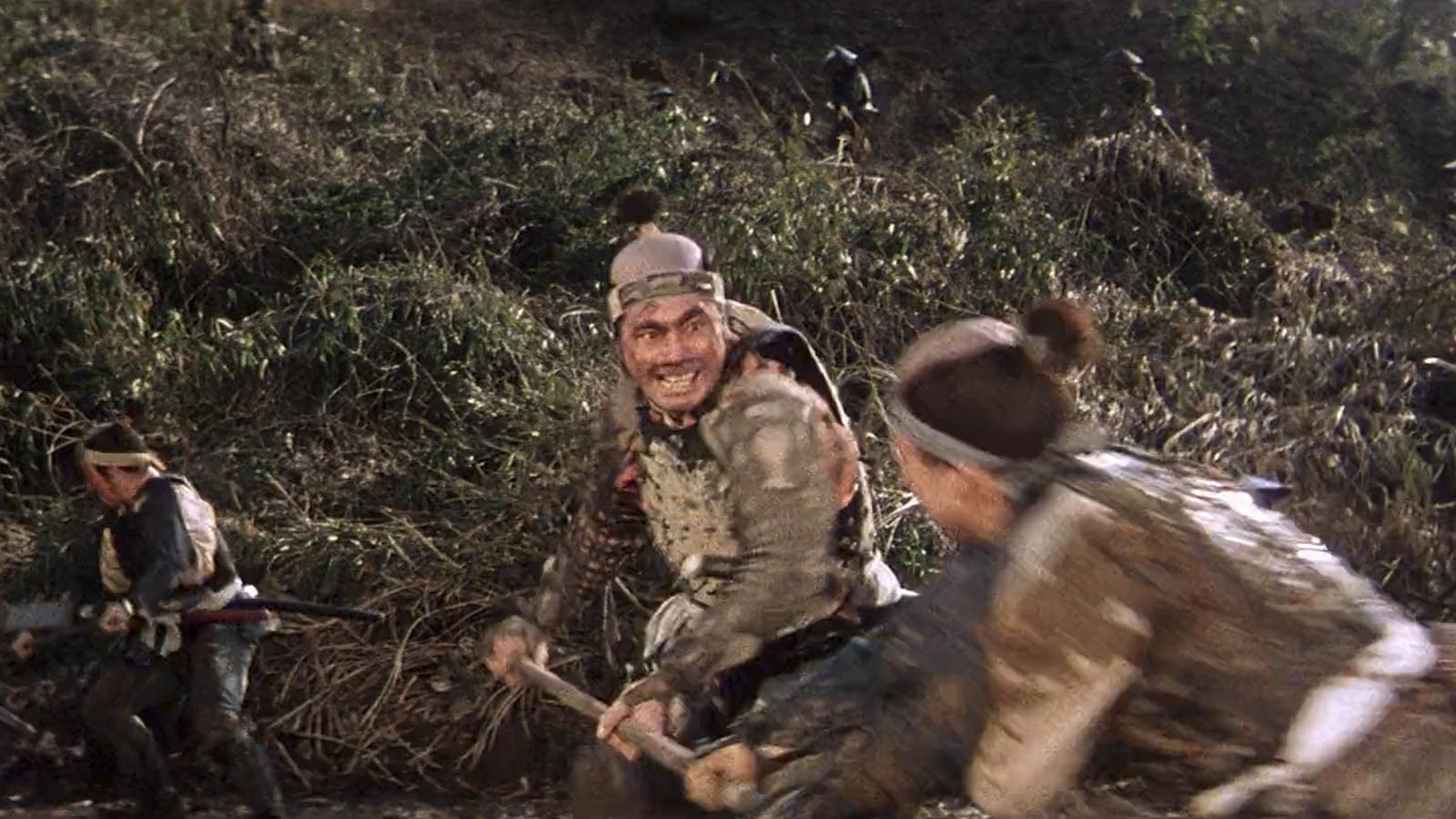
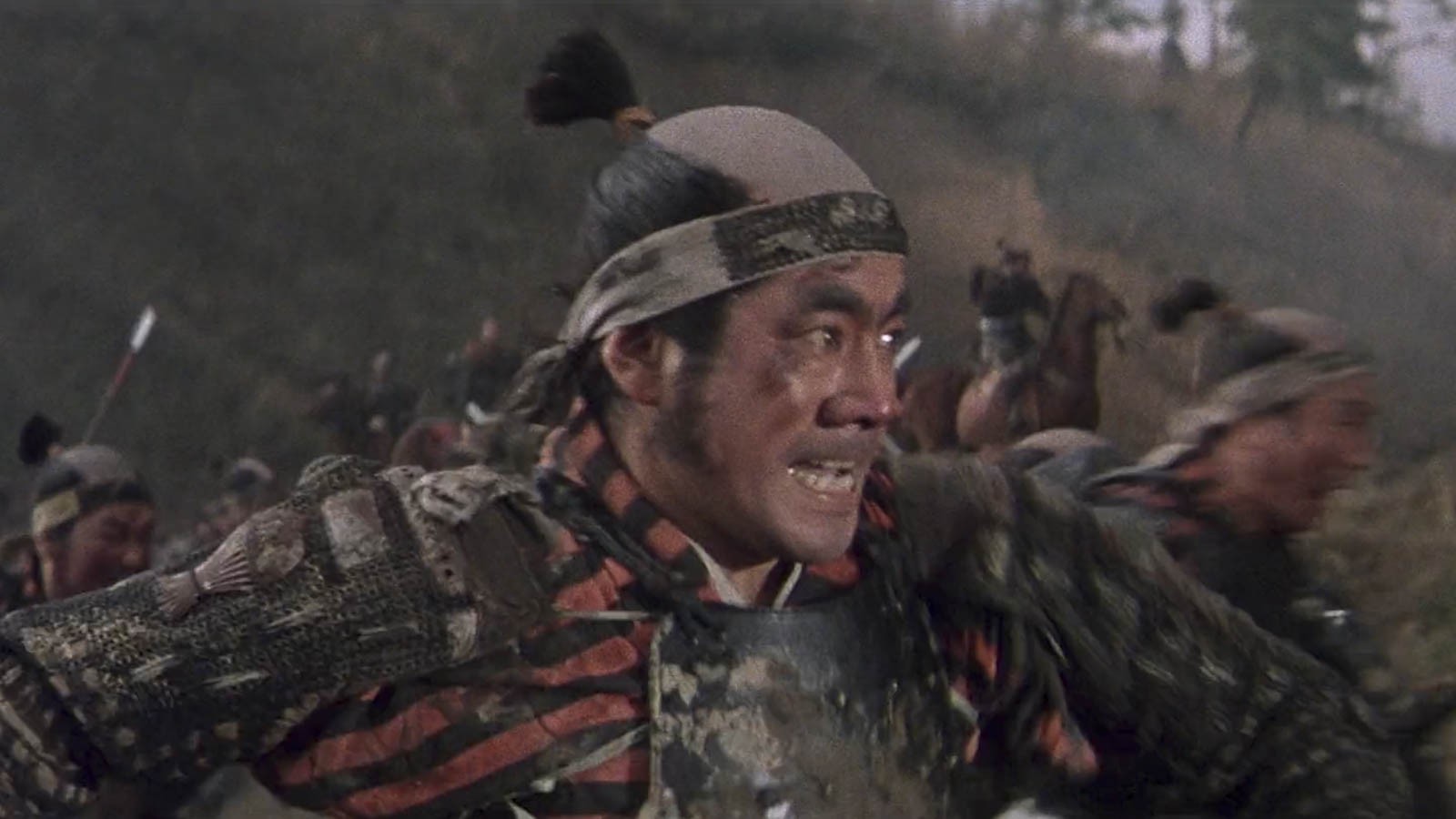
Heihachiro and Jurota are among the losing side at the pivotal battle of Sekigahara and Jurota dies of his wounds. (These guys are in fairly simple, basic armor fighting on foot, and things get pretty muddy.)


Chiyo takes lay Buddhist vows and we see her some years later living at a temple. She and the young nun await Heihachiro's monthly visit. As a lay nun, Chiyo still gets some elegant brocade for her uchikake.

Even ten years after the battle, the shogunate is looking for men who supported the opposition. Akaboshi betrays Heihachiro to ambushers and while he gives a good account of himself, a man drops a roof tile on his head, fatally wounding him. 

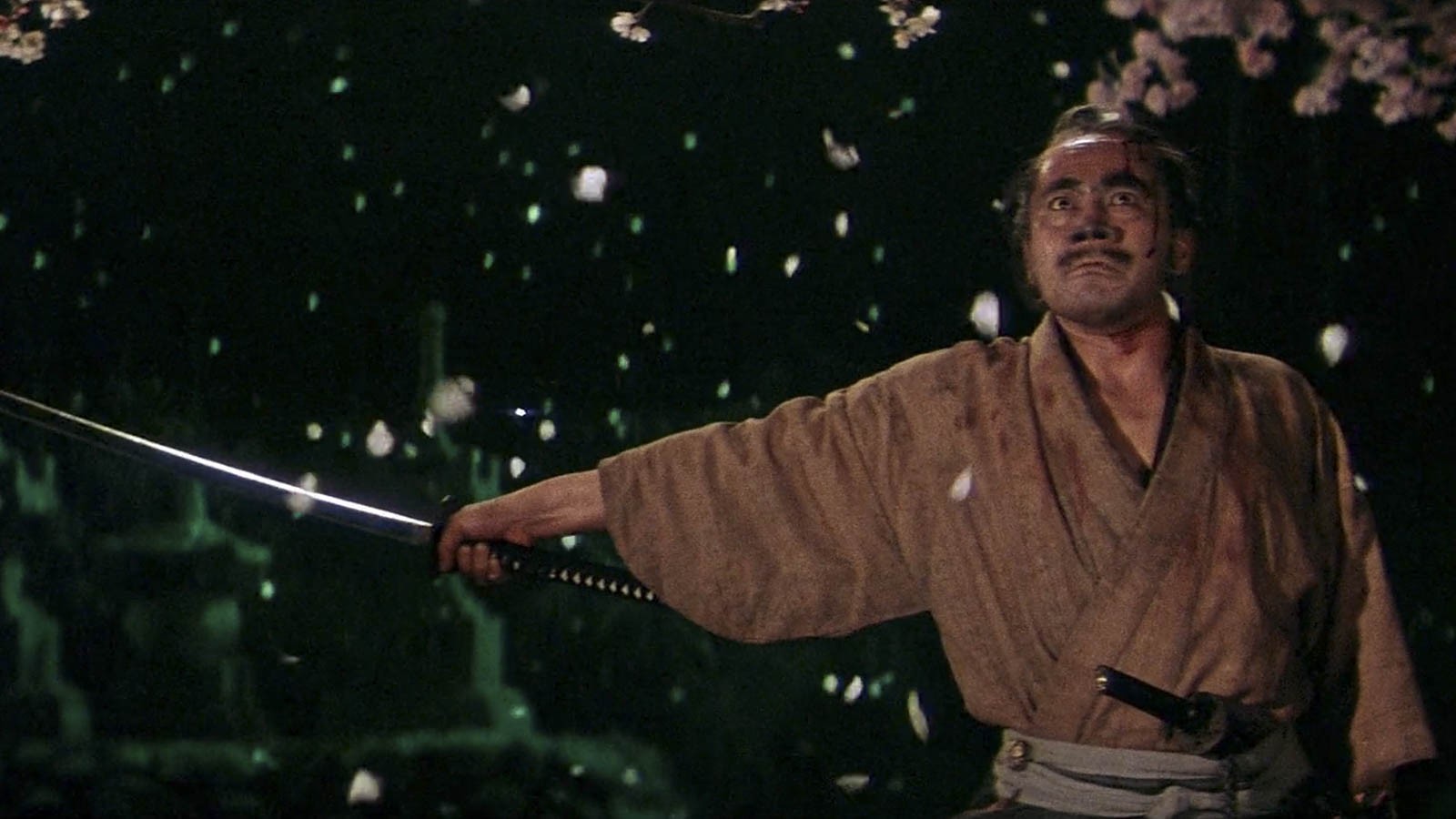
Heihachiro makes it to the temple at dusk, hiding his injury beneath his hat, tells his news and at last reveals his true feelings for Chiyo. In his final battle he duels the falling cherry blossoms. 

I have always loved the Cyrano story, not for the blockheaded blindness of Roxanne, but for the big heart and indomitable spirit of Cyrano. "Samurai Saga" is faithful to the spirit of the original, and frankly, transplanting the story from France to Japan is a good fit for an adaptation. Mifune is at turns funny and heartbreaking, Akira Takarada makes an appealing Jurota - and yes, he's supposed to be a bit dull, and Yoko Tsukasa's radiance as Chiyo reminds me of Olivia de Havilland. Aside from the hair weirdness in the opening sequence, the costuming is very good for the period it purports to represent. 

You may be able to help bring "Samurai Saga" to DVD. Contact Criterion here. I just did. 

gurdymonkey: (Default)
Dear Adam Savage, Lucy Worsley, Ty Franck and Wes Chatham, Jimmy the Welsh Viking, Joanna Lumley, Michael Wood, Robson Green, John Townsend, James May, Mary Beard, Susan Calman, Jill Bearup, Tony Robinson and the Time Team, Henry Louis Gates, Max Miller, Carl Sagan, Bettany Hughes, Nick Hodges, Waldemar Januszczak, Ken Burns, Stephen Fry, Liz of Lizcapism, Brian Cox (the physicist, not the actor), et. al.

Thank you for being there for me.

It has been over a year since I went into lockdown here in Northern California. I live alone, my family are all on the East Coast, and my work duties were cut back to an as-needed, on-call basis. Early on, in an attempt to keep my brain from leaking out of my ears, I made the decision that at least 50% of screen time on any given day had to be educational content of some sort. I explored PBS, subscribed to Curiosity Stream, and of course, discovered that the algorithms at Youtube and Amazon Prime, figured out pretty quickly the sort of recommendations to lob at me.

Even an introvert used to living alone can get lonely, and the sheer necessity of minimizing contact with outsiders only accentuated the fact. It got to the point where I might just pick a thing on Youtube while I was doing chores or answering emails and just let the algorithms choose the next thing, just so there would be some background noise in the house.

As I look at what must be an incomplete list made up of historians, film makers, re-enactors, food enthusiasts, scientists, travelers, actors, and makers, it is your passion for the material you presented that binds you together. And when I needed desperately to hear a friendly voice, your voices were there.

I have had my first vaccine dose. I went out yesterday for an outdoor, socially distanced lunch with friends. The slow march back to the office reopening, rejoining my pre-pandemic activities and social circle is beginning to unfold.

Thank you. Thank you for taking me out of my head, for showing me the world, for making cool stuff, for teaching me about things I didn't know about before. Thank you for doing what you do.

Sincerely,
Lisa Joseph, Alameda, CA
gurdymonkey: (Default)

Previously, on "Shogun," we looked at Shin Nishida's women's cosutmes for the epic miniseries and I theorized about why some of them may be anachronistic. Part 1 on Women's Costumes is available at https://gurdymonkey.dreamwidth.org/964754.html

Our hero, John Blackthorne (Richard Chamberlain), begins his journey as the pilot of a Dutch merchant ship, the "Erasmus." It's 1600, all the European powers are vying for profitable trade in the Far East and Blackthorne is convinced he can get his ship through to "The Japans," which the Portuguese have been visiting regularly for several decades. 

We may as well get the European costumes out of the way first. I showed a couple pictures to a Laurel friend who is a specialist in Elizabethan costuming in the SCA and she compared it to what folks were wearing in the late 70's at Renaissance faires in California. 

Blackthorne's kit consists of a reddish brown jerkin (or is a doublet that is missing sleeves?) with a double roll at each shoulder, linen shirt, breeches, stockings and short boots. His crew is a fairly scruffy assortment of shirts, jackets, jerkins and breeches. Shoes range from what appear to be slip-on turn shoes to laced brogans and even latchet shoes on Vinck. 

Vasco Rodrigues (John Rhys-Davies), the Portuguese pilot who is the best of frenemies if one has to have one, gets a couple of costume changes over the course of the series. Finger rings and a pendant or two, plus some metallic ribbon trims indicate he's made his fortune, though the fabrics are a bit odd. We first see him in this odd abstract "brocade" over brown.

This black ensemble has better breeches, but the "velvet" looks more like velour to me. And that hat is clearly a fedora someone slapped a couple feathers on. The brick red ensemble has a better overall look, complete with lacy bits on his collar.   

 The Jesuits get cassocks with a bit of a wing at the top of the shoulder. I don't know enough about clerical garb of the period and the depictions in the namban screens invariable show them wearing cloaks, but it looks all right. The captain of the Black Ship rates a ruff, but his crew is a mishmash that screams of a night raid on the wardrobe department. It's hard to say what Toho Studios and Shin Nishida had access to, but it is what it is and it manages to serve the story well enough. 

There, now THAT's out of the way, we can move on to where "Shogun" shines: the men's costumes. 

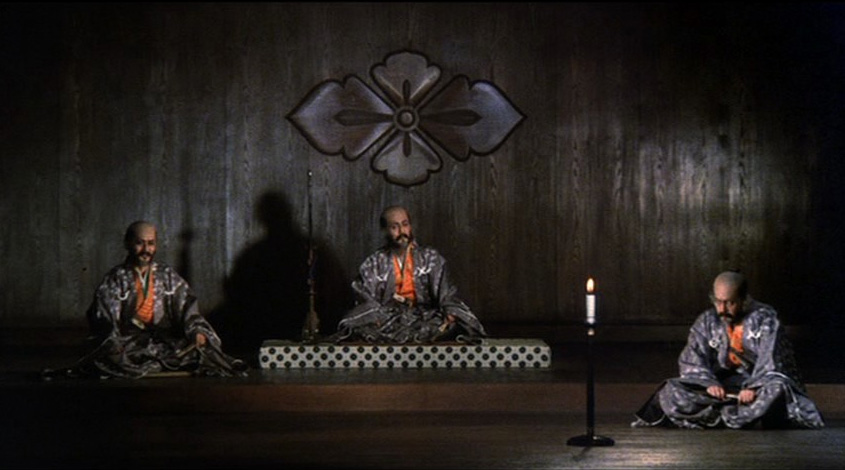
I cannot remember if this was in the novel, but someone realized at some point in the early stages of production that an American audience faced with a large, mostly Japanese cast were going to need some help identifying who was doing what to whom for how many cookies and why. Most of the action is not on a battlefield where waves of colored banners and sashimono tell you which side is which. Thus we have the two principle factions coded by color, not just visually, but in the voiceover narration by the late Orson Welles. Toranaga's people are the Browns and Ishido's are the Greys. It doesn't matter if you are the last ashigaru at the end of the line or General Hiromatsu, you appear on screen in the same color brown as everyone else. That even goes for the men at the top. Ishido (Nobuo Kaneko) is shown in silvery greys, while we first encounter Toranaga (Toshiro Mifune) in golden bronze silk. And when Blackthorne is given Japanese clothing to wear, it's in colors that leave no doubt who he is beholden to!

Left: Toranaga and Ishido confer. Right: Browns surrounded by Greys at Osaka Castle. 

Below left: Omi (Yuki Meguro). Right: Yabu (Frankie Sakai).

Toranaga, played by the inimitable Toshiro Mifune, is resplendent, whether holding court, or learning a hornpipe from Blackthorne. (This is my favorite scene ever so I'm linking to a Youtube clip.)

Once the audience can't NOT know who Toranaga is, he gets to branch out and wear Things That Are Not Brown, such as these hitatare in red (left) and olive green (right). 

Crisp and imposing in that gold jinbaori! Grandfatherly with a vassal's children after having cruelly tested the vassal's loyalty. (Be sure and check out the gold tiger painting on the wall too!

Onward to Blackthorne's transformation to Anjin-san and eventually to samurai. His overall look is grounded in earth tones as an indicator of his alignment with Toranaga. We mostly see him in kosode and hakama, often decorated with geometric designs or simple shapes such as waves, wheels, etc., all appropriate for a samurai of modest rank, while still setting him apart from the more liveried look of the Browns. 

Left to right: coming out of prison in yukata, riding out with Mariko in plain hakama and kikko patterned kosode, walking with Mariko in a kosode with water wheels and a basket-weave design on the hakama. 

The "wifi" symbol is actually a traditional wave motif. Right, detail of another nice brown and brown kosode. 

Dharma wheel kosode and cloud motif hakama. This striped kataginu kamishimo is his most formal look. 

A couple of bonus minor characters who are still beautifully and appropriately dressed. Left, an emissary from the Imperial court (with blackened teeth), right, a functionary who meets with Toranaga in a stunning dobuku decorated with crabs.

In summary, the costume design shines for the men's Japanese clothing, which admittedly didn't change a whole lot going into the early Edo period. The women's costumes contain a few anachronisms, which can be laid to Shin Nishida looking at slightly later styles and making artistic decisions in an effort to differentiate the social status of highly ranked women. 

The historical underpinnings for James Clavell's novel can be associated with the actual events surrounding William Adams and his relationship with Tokugawa Ieyasu. You can read about it on Wikipedia, or dig deeper with Giles Milton's excellent book, Samurai William. It looks like there is a more recent book by Hiromi Rogers called Anjin: The Life and Times of William Samuel Adams 1564-1620 that I may have to give a look. 

At one point in the miniseries, Father Alvito presents Blackthorne with a Japanese dictionary. The Jesuit mission in 16th century Japan has left us a trove of documents about the period: a dictionary, a grammar, manuals describing the customs of the Japanese - and I probably need to do a deep dive on the Jesuits in Japan one of these days. 

Part 1 of this costume deep dive began with Kiku. I made the mistake of watching the DVD featurette about "Geisha" and while the scholarly talking heads don't say anything specifically wrong, it's edited in such a way that the uninformed viewer can only believe that Kiku was a geisha. The first geisha ("art persons") were male entertainers arising in the 18th century, with women later taking that role. In 1600 there were courtesans and prostitutes. Kiku's services are engaged as a gift to Blackthorne, and she is described as being "owned" by whoever holds her contract. The unpleasant reality is that girls would be sold to brothels, often because their own families couldn't afford to support them. It was possible to work off one's indenture, but many girls were unable to escape the system and stayed in the pleasure quarters, frequently succumbing to disease or deaths associated with abortions. Kiku has a "happy" ending when Toranaga makes a gift of her contract to Blackthorne to do as he likes with - and he turns around and gives the contract to her lover, Omi. 

Suggested reading: 

Clavell, James. The Making of James Clavell's Shogun (Delta Books/Dell Publishing, 1980). Out of print, but available used, this large paperback includes production stills, costume drawings and other information of interest to fans. 

Dalby, Liza. Geisha (Vintage/Ebury/Random House, 2007). Dalby's anthropological fieldwork in geisha communities gained her an invitation to study how to become a geisha and provides an interesting view from the inside. 

Frois, Luis. The First European Description of Japan, 1585: A Critical English Language Edition Of Striking Contrasts In The Customs Of Europe And Japan (Routledge, 2014). This account by a Jesuit priest compares the ways of the Japanese with the ways of Europeans. Biases towards Buddhist priests in particular abound, however, it remains an interesting look at late 16th century Japanese life. Rental for Kindle is your most affordable option. 

Milton, Giles. Samurai William: The Englishman Who Opened Japan (Penguin Books, 2003). A readable study on the life and times of William Adams, available in paperback. 

Rogers, Hiromi. Anjin: The Life and Times of William Samuel Adams 1564-1620 (Renaissance Books, 2018). I haven't read it but Rogers writes about the Japanese perspective on Adams, so I just ordered a copy this morning. 


gurdymonkey: (Default)

It was the heyday of the miniseries. "Roots" had set the bar and the major TV networks were vying for novels to adapt. "Shogun" was brought to our screens in September of 1980: in a partnership between Paramount Studios, Toho Studios, Asahi TV and Jardine-Mathieson, it remains the only American TV production to be filmed entirely in Japan. 

Author James Clavell says he was inspired by a single line in his daughter's history textbook, referring to an Englishman who went to Japan and became a samurai. While loosely based on the 1600 shipwreck of a Dutch vessel, the Liefde, and her pilot, William Adams, who went into the service of future shogun Tokugawa Ieyasu, Clavell always maintained he was a storyteller, not a historian. 

Yeah, yeah, I know, GET ON WITH THE COSTUME CONTENT ALREADY. Fine, I'll speak to the historical bits later. 

Initial work on the production, including preliminary research on costumes, sets, etc. reportedly began in spring of 1979 and filming started that June: that gives you an idea of how much time they had to produce and fit costumes. 

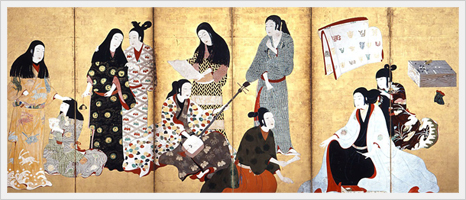
I have not been able to find out much about Shin Nishida, the costume designer. He has no other credits listed in IMDB. The Making of James Clavell's Shogun includes a number of his drawings and shows him at his desk with an open art book before him: I was able to identify the painting shown as one of the Matsuura Screens, a work from about 1650 depicting colorfully dressed women of the pleasure quarters.

One of the Matsuura screens, Museum Yamato Bunkakan, Nara Japan. https://www.kintetsu-g-hd.co.jp/culture/yamato/english.html

You can see the influence on Kiku (Mika Kitagawa), the courtesan character. She looks a bit like the asobime at the Kyoto Costume Museum, with her racy nape-baring updo and her bright clothing. If you look closely at the detail shot, you can see they painted the silk to imitate kanoko shibori, an expensive and laborious dyeing technique. 

This shot shows what she had on underneath that blingy uchikake - a simple dip dyed ombre silk kosode, with the default women's obi configuration for the entire production, a half bow tied at the back. At right, another colorful ensemble. (There will be a Geisha Rant later. I about threw the featurette DVD across the room.)

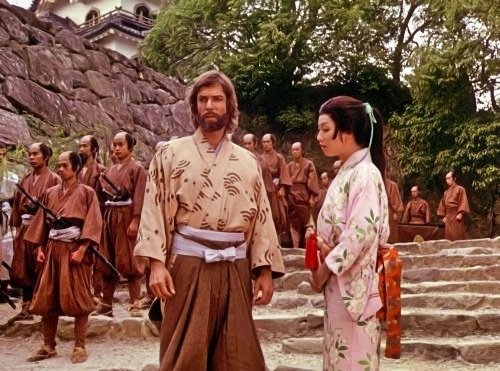
Toda Mariko (Yoko Shimada) is the most important female character: a Christian samurai of fairly high rank, pressed into service translating for her liege lord, Toranaga (Toshiro Mifune) and the outlandish English pilot, John Blackthorne (Richard Chamberlain). Shimada, a last minute casting replacement, had a huge amount of screen time and delivered a beautiful, endearing performance in two languages. 

That screen time means costume changes, but Mariko's wardrobe seems to exist in a world where it is always spring and flowers bloom.

Julia Roberts Signature Color GIF - JuliaRoberts SignatureColor SteelMagnolias GIFs

The Kyoto Costume Museum has a good representation of what a high ranking samurai woman from 1600 might look like. Mariko does - and doesn't - look this way and I have a theory about that. The kind of heavy brocade that her uchikake should be made out of was available, because it was being used on garments for Toranaga and his adversary Ishido (Nobuo Kaneko). If you look closely, you can see that the flowers on many of Mariko's uchikake and kosode have a thin white outline - the telltale sign of yuzen silk painting, a technique that is datable to the 1670s. I think Nishida made a conscious decision to use these drapier, softer looking silks as a signifier of Mariko's high rank and I base that on the fact that he also puts Lady Kiri (Miiko Taka) and Lady Ochiba (Atsuko Sano) in them. You can see it very clearly in the shot of Toranaga sneaking out of Osaka disguised as Kiri. 

When we look at women of more modest rank, you can see the difference. They tend towards kosode with large, repeated motifs that look like they could be resist dyed or stencilled. Fujiko (Hiromi Senno), the young widow given to Blackthorne to be his consort, is an excellent example. 

You can see the contrast between the styles worn by Kiku, Mariko and Fujiko. These three girls appear in one scene to serve sake and giggle over Anjin-san, and their look is similar to Fujiko's. Nice assortment of hair ties in these shots as well. 

Every last peasant and extra gets appropriate clothing too.

This got long quickly, and what do you expect of a nine hour mini-series? I will do a separate post on the men's costumes very shortly. 

UPDATE: Part 2 is available at https://gurdymonkey.dreamwidth.org/964928.html

gurdymonkey: (gurdymonkey2)

I can't figure out how to share this to the Sengoku Daimyo Facebook page (I suspect Ii-dono forgot to give me the appropriate permissions), so it's getting put here. 

The February 2021 of "Age of Samurai: Battle For Japan" on Netflix was sadly, NOT a feast for the eyes of any historical costume nerd. The Canadian production lost its director and had its budget nuked. From orbit, with extreme prejudice. At best it is a confusing jumble of facts spewn by experts whose expertise is undercut by editors who want to make sure you see all the Bright Red Blood and pretty animated maps they did spend their money on. The Covid-19 pandemic didn't help and probably resulted in a lot of shortcutting. Everything is shot at the same locations with a little set re-dressing and it looks like they bought up a bunch of stock armor, vintage kimono and threw it in a pile and said, "Ready, set, go!" At best, we get samurai in solid colored hakama and kimono, at worst, we get Toyotomi Hideyoshi flapping around in home decor fabric so badly sewn you know it was whacked together on an impossible deadline, badly ironed, and flung onto an actor.

Where it does better - and I have to credit Kerry Porter of Ohio Kimono for any influence she had here - is the samurai women. She selected from vintage kimono that resembled the look of 16th century styles and recut and layered them so they actually look pretty good. In this screenshot, for example, she used a colorful robe for the outer layer, you can see an appropriate number of layers at the collar line and an obi recut to a narrow, front-tied style which is appropriate for the period. 

A shame, really. It could have been good.

All of which brings me to the 1980 Akira Kurosawa film, "Kagemusha ("Shadow Warrior)." This is the one that Francis Ford Coppola and George Lucas threw financial and artistic support behind when Toho Films couldn't afford to complete the film. 20th Century Fox got international film distribution rights out of the bargain and we got a veritable feast for the eyes and a compelling story about a peasant with a striking resemblance to daimyo Takeda Shingen. Here we see Shingen (center), his brother Nobukado (left) and the kagemusha (right). All three are wearing the same hitatare kamishimo outfits, but the body language tells all. The peasant, just spared from crucifixion, has no choice but to agree to be a body double for the warlord. (Shingen and the peasant are both played by the incomparable Tatsuya Nakadai.)


Back in the early 2000s when I was still living in Oakland and getting into portraying a Japanese in the SCA, I first saw this film. My exclamations over the costumes by Seiichiro Hagakusawa were so loud and frequent that they rousted my roommate from his video game in another room to find out why. 

Hagakusawa replicated extant 16th century garments and put them on the characters. Here's Oda Nobunaga (Daisuke Ryu) wearing one inspired by a pieced dobuku owned by Uesugi Kenshin. (Spare some love for the retainer in the red and white ombre dyed kataginu kamishimo too!)


And another which was given by Toyotomi Hideyoshi to Nanbu Nobunao. (This one is in the Tokyo National Museum.)


And Tokugawa Ieyasu is in a version of another extant garment.   


Nobunaga's informal ensemble is based on a well known portrait.  

Netflix's samurai and daimyo all look underdressed. "Kagemusha's" peasants get decorated clothing and retainers wear livery

Feudal Japan was hierarchical. Clothes denote not only who one is but how much power they wield, how much respect they demand, how much deference they give to their superiors, and so forth. If you go back to the head of this entry to the shot of Shingen, his brother and his peasant double all wearing identical outfits, the body language tells you who is who. 

In feudal Japan you also dress for what you're doing, for what the occasion demands, whether your overlord is holding court or you're making battle plans. 


We even get glimpses of what the women of Shingen's circle would wear. Multilple layers and the woman at right has worn her uwagi koshimaki fashion. And let's enjoy that bright yellow dobuku the kagemusha wears here as he tries to pass with women who knew Shingen intimately: even the daimyo wears flowers. 

In fact his outfit is so scrumptious, let's get a better look as he feigns drunkeness to deceive his women. 

I would happily wear any uwagi in the shot below. Look at everyone in this shot. Look at the peasants at the back. 

The V&A even has one of the costumes in their collection. Go here to see. 

Film costumes are not documentation for SCA purposes, but these are so well done.  Hagakusawa had the budget and the access to the right textiles, properly embellished and used, he copied museum pieces for several costumes. Everyone, including people in the background, looks as they should. 

Here's Nobunaga flaunting a European cape. Spare a glance for the guy walking at his stirrup:neat, crisp, decorated textiles. 

Cute grandson is cute - and dressed as his station befits. 

Less formal women's clothing. 

This is a terrific movie for a lot of reasons: it works as the historical fiction that it is and tells a tale of a man trapped by circumstance into pretending he is someone else. The battles are epic and heart rending. Nakadai is at the height of his powers in not one but two roles. Truly, "Kagemusha" is a feast for the eyes - and I can't wait to sit down and watch it again. 

gurdymonkey: (Default)

Last week, while reviewing the matcha I had, I posted some internet sources that claim shade-growing dated to the early 19th c.

While watching the "Matcha" episode on "Trails to Oishii Tokyo" on NHK, featuring a visit to a tea grower in Uji, the program stated it dated to the 16th c. Clearly more research was indicated!

The following is from Joao Rodrigues's Account of Sixteenth-Century Japan, translated and edited by Michael Cooper for the Hakluyt Society, 2001, pages 272-273 in a chapter which describes tea production and compares the Chinese and Japanese methods of entertaining with cha.

"Its new leaves, which are used in the drink, are extremely soft, tender and delicate, and frost may easily make them wither away. So much damage can be done in this way that in the town of Uji, where the best tea is produced, all the plantations and fields in which this cha is grown are covered over with awnings or mats made of rice straw or thatch. They are thus protected from damage by frost from February onwards until the end of March, when the new leaf begins to bud. They spend a great deal of money on this for the sake of the profit that is to be obtained, as we shall say, for the trade in cha is very great." 

"In Japan, the best [cha] is grown only in the town called Uji, three leagues from the court of Miyako, whence it is taken to all parts of the kingdom. The cha leaves used in the drink are the soft new ones and the first to sprout in the spring in march, when they are picked. Just as in our vineyards, so too this crop is brought in by large numbers of people, who can distinguish the good new leaf that is to be picked from the old and inferior one that is left." He goes onto describe steaming, lightly roasting in baskets while constantly moving the leaves by hand, going on to say that the Chinese will drink it "cooked in hot water," while the Japanese prefer it ground into powder. 

The rest of the chapter describes packing, distribution and how the Chinese serve their guests without ceremony. A further chapter details what we can recognize as cha no yu, the Japanese tea ceremony. 

Rodrigues lived in Japan from 1577 until 1610, arriving as a teenager. He picked up Japanese quickly and, after a briefish trip to Goa to be ordained a Jesuit priest, returned. His ability as a translator meant he knew a lot of the feudal movers and shakers. Toyotomi Hideyoshi (who was suspicious of foreigners) was nonetheless so impressed with him, he took him on as personal interpreter. Additionally, he produced a Japanese grammar, Arte da Lingoa de Iapam (The Art of the Japanese Language). His "History" was written in the early 1620s based on his experiences and recollections and was to have been part of a multi-volume opus on the Jesuit mission in Japan. Only one volume survives. It's a clunky read - Rodrigues did not consider himself a good writer and expected someone else would come along and pretty up his data dump. Translator Michael Collins describes the challenges in cleaning up repetitions and so forth. That said, it's a remarkable bit of source material, not only for its detail, but for Rodrigues' sympathetic view of the people he was describing. 

*******

Today's tea was the Ippodo hojicha. I brewed it a little weaker today. Flavor is still quite nice, if not as in-your-face. 6g/150ml, 200F, multiple 45 second steeps. 

gurdymonkey: (Default)

Some years ago at Estrella War, I taught my "period traditions in tea" class, which included tasting matcha. There was an earnest young man in a poet shirt and kilt who had waxed romantically about having seen "Shogun," and being deeply affected by the tea ceremony scene in which Mariko and her estranged husband engaged. EYM's eyes lit up as I heated water on a camp stove, offered my standard disclaimer about not having formally studied tea ceremony. I whisked up  a ceremonial grade matcha I'd bought in San Francisco's Japantown and sent a couple bowls around the table for people to taste. EYM's took the bowl reverently in his hands, sort of remembered he was supposed to turn it, did so, and vanished into its depths. The appalled, crushed look on his face as he reappeared was that of one whose dreams had been dashed by the bitter grass, seaweed and earth flavor that had invaded his tongue. I assured everyone that it was OK if they didn't like it. 

What is matcha? Simply put, it's powdered green tea. The Chinese practice of grinding tea leaves which had been steamed and dried was brought to Japan in the 12th century by the monk Eisai, who learned it from Chan (Zen) monks. This method of preparing and serving tea was the norm in Japan throughout the medieval period, it was what was done as Zen practitioners such as Murata Juko, Takeno Joo and Sen no Rikyu developed what we know as tea ceremony today. 

Like gyokuro (see yesterday's post), modern matcha is shade grown, the finest buds are picked and dried. The stems and veins are removed, then what is left of the leaves is milled into a fine powder. The grinding process must be done slowly, so that heat build-up doesn't affect aroma or flavor. (Shade growing developed during the 19th century.) EDIT: A feature on NHK 's "Trails to Oishii Tokyo" claimed that shade growing dates to the 16th century. More on this here. https://gurdymonkey.dreamwidth.org/951270.html

Nodoka means "serenity. This matcha is a limited spring release from Ippodo, arriving in a pretty pink box decorated with camelia blossoms. At $17 for 20 grams, it's relatively inexpensive compared with tea ceremony grades. (The website says it will be available through April unless they run out.)

Made as usucha (thin tea): 2g/80ml water brewed at 175 F, whisked vigorously for 15 seconds, per instructions from Ippodo. For "thick" koicha, they recommend 4g/30ml. The website also included matcha latte instructions. 

Nice fresh, grassy green color and aroma, got a decent foam, which abated slightly as I fumbled for my camera. 

Because this is a ground powder, you're getting a concentrated hit of flavor, theanine and caffeine in a relatively small volume of liquid. Japanese greens combine bitter and savory (umami) flavors, but the balance on this one is quite nice. The astringency is there, but it's not overpowering, and there's a little hint of sweetness as well.

In tea ceremony, matcha is traditionally paired with a sweet of some sort. I had mine with a vanilla wafer cookie.

Because the flavor is not sharp and overly bitter, this would make a very nice "gateway" matcha. 

Matcha-as-food-flavoring has become very popular. Because it has to blend or compete with what else is going on in the food it's going into, it tends to be much stronger than drinking matcha. Know what grade of matcha you're looking for before buying.

https://ippodotea.com/collections/matcha
gurdymonkey: (Default)

I know, I wasn't going to order more tea - but I did. Honestly, as vices go, it's not a bad one to have.

My tea order arrived last night. I was mildly alarmed that the box felt soggy - probably got wet leaving distribution center in Pennsylvania. Fortunately, the teas were packaged in sealed foil. The pretty pink box with camelia blossoms on it is Ippodo's limited spring release Nodoka Matcha. The white packet is one of their gyokuro teas. 

What is gyokuro? It's a Japanese green tea. Tea flavor is affected by several things, (a) terroir (e.g., environmental factors such as climate, weather, soil and water), (b) when it's picked, and (c) how it's processed after it's harvested. Gyokuro's flavor is manipulated before harvesting by artificially shading the tea plants for 20 days or more before  picking. 

https://japaneseteasommelier.wordpress.com/2017/09/15/understanding-gyokuro/ explains the process and includes photos of the shading arrangements. 

One of the reasons I'd never had it before is that all that extra care is reflected in the price. In the past I'd been reluctant to buy something I hadn't tried before. On the other hand, "jade dew" is so poetic - and I'm a sucker for poetic. Plus all those Japan travel shows with people oohing and ahhing over their first taste of this stuff. 

However, I'm now on Ippodo's mailing list and they were running a special on the spring matcha - and if I added another thing to my order the shipping would be free. Based on the sencha and hojicha I'd gotten from Ippodo last month, I decided to pull the trigger on a 50g packet of one of their gyokuro varieties. 

Gyokuro is considered a delicate tea. My kettle's lowest setting is 160F, however, Ippodo recommended brewing at 140F. I was less precise with measurements, as I used the little hohin, but it's probably close to 8g/80ml if I had to guess. I cooled the water down old-school style by pouring into a room temperature Pyrex measuring cup, then pouring into another cup (also room temp), then pouring over the leaves in the hohin. First and second steeps were about 90 seconds. 

Scent out of the packet was classic Japanese green, very refreshing. As for the flavor, if you've ever had a decent sencha, dial the astringency all the way down and leave the vegetal umami* flavor. There was a hint of sweetness on the finish. Went really nicely with a slice of buttered rye toast. 

Still delicious cold - not surprisingly the second steep went cold pretty quickly while I was putting this post together. 

If you're not crazy about green tea, pass this by unless you can taste it first. It's an expensive specialy tea that fills a particular niche. However, once the pandemic lifts, if you have a local tea shop that has it and offers tastings, that would be a good way to check it out. 

I'm probably going to get a few more steeps and be sipping on this one all day. 

I realized I use the term umami a fair bit when describing Japanese teas. So what is it? 

Pronounced like "Oooh, mommy!" Dictionary.com describes it as a strong, meaty taste imparted by glutamate and other amino acids: often considered to be one of the basic taste sensations, along with sweet, sour, bitter and salty. I just heard John Townsend refer to something as 'food flavored" in one of his historical cooking videos. It's kind of like that - you'll know it when you taste it. Specifically with green teas, I associate it with a strong spinach-like scent and flavor. Umami is also associated with soy preparations like soy sauce and miso. 

All that said, taste is extremely subjective. You and I could taste the same item and pick up on completely different sensations. 

gurdymonkey: (Default)

Some years back I bought a package of a black tea with rose petals in it and what a mistake that was. I think I drank one cup and never touched it again. (It was in the tea cleanout I did last week.) So I've been leery of teas with flowers. Uncle Iroh, the character from the "Avatar" series, is a fan of jasmine tea and I know it's a real thing, but I wasn't sure I wanted to go there yet.

Anyway, last week when Jade mentioned Old Ways Tea and I browsed their website, they had a black tea scented with osmanthus flowers in a 5g package, for only $1.75. Just enough to sample without a major commitment or expenditure. Why not?

Not surprisingly, it smelled lovely when I cut open the little packet. A toasty black tea scent predominated, complimented by, rather than overpowered by the flowers. The leaves were black, tightly rolled and tiny fragments of orange osmanthus petals were visible. Not knowing different, I steeped it at 200F for 30s in the gaiwan, because it's a black tea. It handled that ok, but it could have gone for a shorter, cooler first steep, perhaps 190F (oolong range) for 15-20 seconds.

It's a nice, delicate black tea with a hit of honey sweetness at the back. The floral notes are light and subtle. Having tried this, I am now willing to try a proper jasmine tea.

(When I mentioned it on Facebook, Jade said it was good with cheddar cheese and garlic crackers. I grabbed a piece of Tillamook sharp cheddar and tried it. Then I broke into a bag of white cheddar Simply Organic Doritos. Jade commented that black teas are generally what the Chinese drink with food, so that explains it, I guess. Insane how good this tea was with a few chips!)

Second steep, 30s/190F. Third steep, 45s/190F, flavor and scent remained good. By the fourth steep, 60s/190F, the flowers were done, but it was still a nice mild cup of black tea. 

Notes have been added to my tea spreadsheet!

Profile

gurdymonkey: (Default)
gurdymonkey

February 2026

S M T W T F S
1234 567
891011121314
15161718192021
22232425262728

Syndicate

RSS Atom

Most Popular Tags

Style Credit

Expand Cut Tags

No cut tags
Page generated Mar. 2nd, 2026 05:49 am
Powered by Dreamwidth Studios